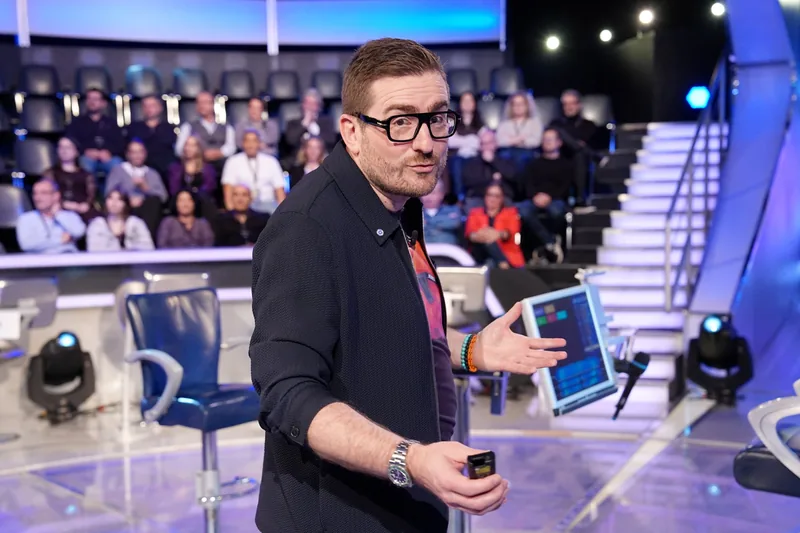
I did not sit in Günther Jauch’s chair. On my slides, FRED took the contestant’s seat instead. I stood next to it, in front of around 60 people from agencies and publishers, in the studio of the German “Who Wants to Be a Millionaire?”.
RTL AdAlliance had invited guests to its SMB Summit on 3 and 4 November 2026. The motto: “TV meets SMEs – the effect of video advertising for small and medium-sized businesses”. The first day, at RTL in Cologne, was about media and programme planning. The second day took place for the first time in the “Who Wants to Be a Millionaire?” studio at EMG Germany in Hürth.
The occasion
What the organiser wanted
Among small and medium-sized businesses, TV advertising is seen as too expensive and too scattered. The summit set out to show that this has changed: TV advertising that only runs where potential customers are, regionally and at an affordable price. In the studio sat the people who plan such campaigns for their clients. My topic for 30 minutes: “Neuromarketing. How brands form in the mind.” (The talk was in German.)
Quiz
Three questions, four answers
In this studio there is no getting around quiz questions. So there was an audience lifeline, and the room got to vote.
Question one: participants drink cola blind from two unlabelled cups while their brain activity is measured. What shows up? No reliable differences. Only the label makes the difference.
Question two: for how many of the ads tested is the brand attributed wrongly or not recognised at all once the logo is missing? For 48 per cent. The figure comes from an analysis by the consultancy decode, led by Christian Scheier and Dirk Held, who examined several thousand ads from 2003 to 2006. It refers to the ads, not to people: almost every second ad could not be recognised as its own brand without the logo. This is not a peer-reviewed study, and the data are a good 20 years old. Still, the question makes you think: would anyone recognise your ad without the logo?
Question three: how many of our decisions are made by the autopilot rather than the conscious mind? 95 per cent. This figure has been doing the rounds in the literature for years, and you should not take it to the decimal point. The direction is right all the same.
Brands in the mind
How brands form in the mind
Our brain is anything but rational and fairly lazy. It thinks in pigeonholes, decides from the gut and keeps calculating: reward minus cost. At the same time, depending on the estimate, 5,000 to 13,000 advertising messages a day rain down on us. Neuromarketing is not a button that triggers buying decisions. It is many small steps that make things easier for the brain.
To me, a brand is a recognisable system of meaning, trust, emotion and appearance. It gives orientation. My favourite example: two cups of coffee overlooking a mountain lake. One costs €6.90, the other €3.90. The expensive one carries a green logo. Starbucks does not sell coffee, Starbucks sells a little piece of holiday.
Brands are frames and paths in the brain. The more often we walk a path, the wider it gets. That is why repetition, strong images, easy-to-read text and other people who already like something all work. You will find more of these effects in my effect library.
TV advertising
What this means for TV advertising
Two effects play into the hands of TV advertising. What we see often and vividly, we consider important and common. And anyone who advertises on TV sends a signal: this company must be good, otherwise it would not be on TV. Some of the channel’s shine rubs off on it as well.
With TV advertising that runs only in selected households, this becomes affordable for companies that until now have only thought of posters or social media. Which leaves the real question: what should stick in people’s minds from those 20 seconds?
Takeaways
Three things to take away
Use the pigeonholes in your customers’ heads and stage your brand. Think of brand management and neuromarketing together. And an experiment to try yourself: in an office kitchen, more money ended up in the coffee kitty as soon as a picture of eyes hung above it. The brain feels watched, even though it knows it is only a picture.
Thanks to Fabian Burgey and the RTL AdAlliance team for the invitation. The photos are by Stefan Gregorowius.
Matching keynote
Who this keynote is for
For media sales houses and broadcasters inviting their advertising clients, for agency events, business days and customer events. The closest match is the keynote Brands. Bring. Business., and for SMEs also Neuromarketing for SMEs.
FAQ
Frequently asked questions
How long is the keynote?
In the studio it was 30 minutes. Anything from 20 to 60 minutes is possible.
Can it include interactive elements?
Yes. The quiz questions can be adapted to any occasion, even without a TV studio.
Is the keynote available in English?
Yes.
About the author
Christian Dietz
Christian Dietz is a neuromarketing speaker and managing director of the agency NEUBLCK. He gives keynotes for companies, associations and conferences across the German-speaking countries, and in English on request.
This keynote for your event
Tell me briefly about your event. I usually reply within 48 hours.