Ten short questions, no thinking required. Go with your gut. Afterwards FRED explains what just happened in your head and what research has found out about it.
Two new ice cream flavours, same recipe. Which sounds creamier?
Choose your answer:
Frosh, then. That is what the research would have guessed, too.
Frish? That goes against the study.
“A dark O, and I think of cream. Don’t ask me why. I just do.”
The researchers Eric Yorkston and Gita Menon tested this ice cream in 2004. It was made up, only the name changed. “Frosh” was rated creamier, richer and smoother than “Frish”. The only difference: a dark O instead of a light I. Most respondents were still sure that the name had not influenced their judgement.
For brand names, that means the sound helps sell, before anyone knows what the name means.
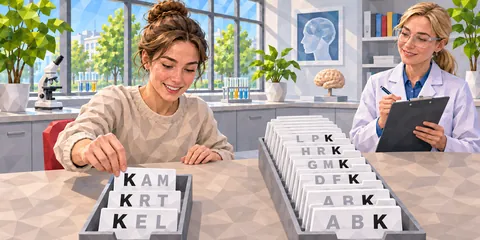
In English, are there more words that start with K, or more words with K as the third letter?
No counting, just guess.
Choose your answer:
Wrong. But in very good company: that was FRED.
Correct. Your head outvoted FRED. Or you smelled the trap.
“Kitchen, king, kiss: they come to me at once. With make, joke and bike I have to search first. And what comes to mind quickly, I take to be common.”
In English, K appears about twice as often as the third letter than as the first. When Amos Tversky and Daniel Kahneman asked the same question in 1973, also for L, N, R and V, 105 of 152 people guessed the start of the word for most letters.
The two called this the availability heuristic: we judge how common something is by how quickly examples come to mind. Most of the time that works well. Here it leads us astray.
Your office needs a bean-to-cup coffee machine. Which one do you take?
Models and prices are made up for this test.
Choose your answer:
The middle. Welcome to the club.
Thrifty. You avoid what many go for: the middle.
Treat yourself! Premium would have nudged most people towards the middle.
“Very cheap? Could be junk. Very expensive? Could be a rip-off. The middle feels safe. No need to think.”
Itamar Simonson and Amos Tversky showed in 1992 that a product is chosen more often once a more expensive tier sits above it and it ends up in the middle. Nothing about the product itself changes. It just gets a new neighbour. A meta-analysis of 142 experimental results confirms this, but how strong the effect is varies from experiment to experiment.
For price lists, that means the expensive top tier does not only sell itself. It strengthens the tier below.
What percentage of United Nations member states are in Africa?
Spin the wheel first, then guess.
Is the share higher or lower than per cent?
Caught: your guess leans towards the number on your wheel.
Respect: the wheel left you cold.
“The number was random? I know. I still hold on to it. I have to start somewhere.”
The right answer is around 28 per cent: 54 of the 193 member states are in Africa. Your wheel showed , and you guessed per cent.
Amos Tversky and Daniel Kahneman described this experiment in 1974. Their wheel secretly stopped only at 10 or 65. People who had seen the 10 guessed 25 per cent on average, those who had seen the 65 guessed 45 per cent. The number was obviously random and still pulled the guesses in its direction. The wheel here also only knows 10 and 65, by the way.
In retail, the crossed-out price lives on this: if you have seen €199, €129 looks cheap.
Same kettle, same price, two shops. Where do you order?
Choose your answer:
4.4 stars. Sounds odd, but it is typical.
The perfect 5.0. Logical thinking, but FRED sees it differently.
“Only top marks? Something is off. A few grumblers make the whole thing believable to me.”
In 2017, the Spiegel Research Center at Northwestern University analysed, together with the review service Power Reviews, which star ratings sell best. The likelihood of purchase was highest at 4.2 to 4.5 stars and fell again above that. Perfect scores seem too good to be true. Many people look specifically for bad reviews, and if all they find is praise, they quickly suspect bought stars.
Even a few reviews make a big difference: with five reviews, the likelihood of purchase was almost four times as high as with none.
A coin is tossed. Heads, you win €150. Tails, you pay €100. Do you play?
One toss, real money.
Choose your answer:
Better not. FRED decided there.
You play. Smart on paper, FRED would have waved it off.
“Losing €100 hurts me more than winning €150 pleases me. The coin stays in my pocket.”
On paper, the game is worth playing: on average, each toss brings in €25. Still, many people say no. Daniel Kahneman and Amos Tversky explained why in 1979: losses weigh more than equal gains. Kahneman puts the ratio at 1.5 to 2.5. To make up for a loss of €100, the mind needs a gain of €150 to €250. Our offer was at the very lower end. Kahneman received the Nobel Prize in Economics in 2002 for this theory. How strong the effect is depends on the situation, according to more recent work.
For offers, that means free trials work because cancelling later feels like a loss.
Same cookies, two jars. One still has ten, the other only two. Which cookie tastes better?
Choose your answer:
The last two. They must be good, right?
True, they are the same. Your head was faster than FRED.
The full jar. FRED must have been looking elsewhere.
“Only two left? Then others have already grabbed some. I want those, too.”
Stephen Worchel, Jerry Lee and Akanbi Adewole tested this in 1975. The same cookies were in the jar either ten at a time or just two. The scarce ones were rated higher. They were most desirable when the jar was full at first and then became scarce because other participants needed cookies. The test took place in a lab, with around eleven people per group. A 2022 meta-analysis by Barton and colleagues confirms, however, that scarcity increases purchase intent.
For online shops, that means “Only 2 left in stock” helps sell. The message still has to be true.
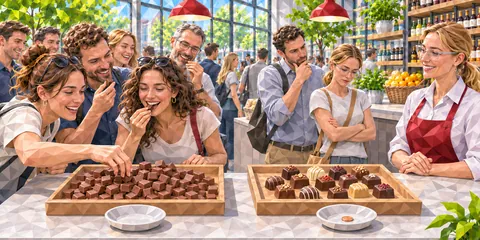
At the counter you may take one chocolate. Which one?
You have small change with you.
Choose your answer:
Free. FRED does not do much maths there.
The truffle. Much more enjoyment for 14 cents, well calculated.
“It costs nothing? Then I can’t go wrong. Grab it!”
Kristina Shampanier, Nina Mazar and Dan Ariely tested this with chocolate in 2007. At first, a Lindt truffle cost 15 cents and a plain Hershey’s Kiss 1 cent. Three out of four who took one chose the truffle. Then both became one cent cheaper: truffle 14 cents, Kiss free. The gap stayed the same. Still, more than two thirds now went for the Kiss.
To the brain, free is a category of its own. It stops calculating and just grabs. With expensive products, the effect is weaker.
Same pudding, same price, two names on the menu. Which do you order?
Choose your answer:
Satin. Sounds creamier, so it tastes that way.
The plain one. You don’t let adjectives tell you what to think.
“Satin? I can already taste something. With the plain pudding, nothing happens for me.”
Brian Wansink, James Painter and Koert van Ittersum tested this in 2001 over six weeks in a canteen at the University of Illinois. Six dishes appeared on the menu, sometimes with a plain name and sometimes with a descriptive one. “Chocolate pudding”, for example, became “Satin chocolate pudding”. With the descriptive name, the dishes sold 27 per cent better, and diners thought they were of higher quality. They were not willing to pay more for them.
For product copy, that means a good word on the menu changes how something tastes.
Insurance for your bicycle. Which offer sounds cheaper?
Choose your answer:
€1 a day. Sounds like nothing. Providers count on that.
Both the same, correctly calculated. FRED would have taken the euro.
€365 a year. You prefer to see the whole sum right away.
“One euro a day? Less than a coffee. I don’t need to think about that.”
John Gourville of Harvard Business School investigated in 1998 why such conversions work. His explanation: the mind compares a small daily rate with small change like a coffee on the go. An annual amount lands among the bigger expenses that people think about.
There are many examples. A student ticket in Hesse is advertised at €1 a day instead of €30 a month. Home contents insurance costs €3.67 a month instead of €44 a year.
FRED stands for the autopilot in your head. It decides fast, by feeling, and preferably without effort. That is not a flaw, it is the same for everyone. Your answers at a glance:
The audience at my talks has these aha moments too, with examples from advertising and online shops.