










Enquire
  1. Home
  2. Talks
  3. Sabotage in Your Head

Keynote · Christian Dietz

Sabotage in Your Head: a keynote about how the brain sets traps

Abstract for the programme

Length: 30 to 45 minutes

Why do we keep falling for fake news and manipulation? In the keynote “Sabotage in Your Head”, Christian Dietz shows which thinking traps our brain sets and how advertising, politics and social media exploit them. Easy for everyone to follow, no prior knowledge needed.

In his keynote “Sabotage in Your Head”, Christian Dietz draws on neuroscience to show why our thinking keeps falling into the same traps and why fake news and manipulation find it so easy to get in. Our subconscious judges information faster than reason can check it. Whether advertising, politics or social media: anyone who knows the mechanisms behind communication becomes harder to steer. The keynote is for everyone, in private life and at work, and requires no prior knowledge at all.

Enquire about this keynote

★★★★★4.9 / 5 from 48 reviews

35 on OMT: 4.9 (omt.de) · 13 seminars and talks: 4.94 (provenexpert.com)

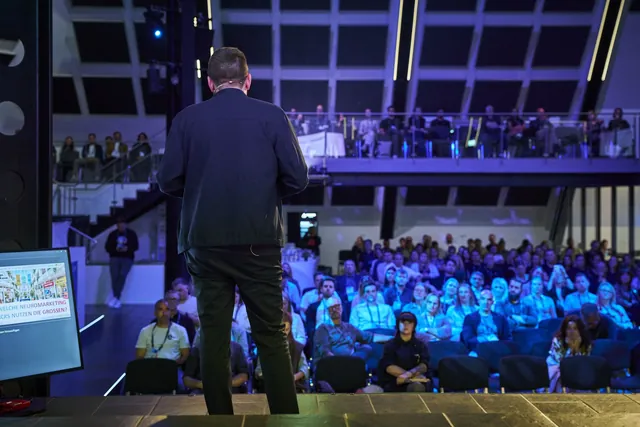
Neuromarketing keynote at OMT 2026: view from the stage over Christian Dietz into the packed hall

What the audience takes away from the keynote

Christian Dietz shows

  • why our brain takes shortcuts when thinking,
  • why the subconscious often decides faster than reason,
  • what makes fake news so effective,
  • how advertising, politics and social media play on our feelings,
  • how to recognise manipulative communication,
  • and which simple questions help us decide more consciously.

After the keynote, the audience looks at headlines, posts and advertising messages differently.

Who is the keynote on thinking traps and manipulation for?

For everyone, in private life and at work. The keynote suits customer events, staff events, conferences, associations, educational institutions and community events. People who assess a lot of information in their jobs, or want to reach others through communication, take away the most. Having a brain of your own is the only entry requirement.

Suits

  • Customer events
  • Staff events
  • Conferences
  • Associations
  • Educational institutions
  • Community events

Available as

  • Keynote
  • Talk
  • Seminar
  • Workshop

Slides

This is what the slides look like.

Every slide is a picture, often starring FRED. The brain remembers pictures more easily than bullet points. That’s the whole trick.

Low-poly illustration: FRED in sunglasses in front of a high mountain with a winding path
The mountain before the purchase
Low-poly illustration: Christian Dietz holding a gift with FRED, arrows saying “Just for you” and “Only 1 left”
Scarcity: only one left
Low-poly illustration: stone-age people fleeing from a sabre-toothed tiger
Stone-age brain: run first, think later
Low-poly illustration: FRED on a deckchair thinking about ice cream and money, Christian as the ice-cream seller
Reward or feeling? What FRED is thinking on the beach
Low-poly illustration: Christian Dietz on a rotten rope bridge with a sign saying “Help!”
The wobbly rope bridge
Low-poly illustration: people cheerfully jumping onto a decorated train
Bandwagon effect: everyone jumps on board
Low-poly illustration: Christian Dietz next to a pair of scales on which a picture outweighs a sheet of text
A picture carries more weight than any text
Low-poly illustration: coin-toss bet with FREDO notes, 133 against 100
Loss aversion: how much do I have to win before I’ll take the coin-toss bet?
“Added value that stays in your head. Science explained with examples that stick.”
Ivonne Wolter · Zeltkinder (omt.de, translated from German)
“I couldn’t look away – I love these visual slides.”
Kristin Siebert · Leap digital (omt.de, translated from German)
“Every theory was anchored with concrete examples and real website cases. The frameworks presented can be applied straight away – I took a lot away.”
Denise König · Lime Technologies (omt.de, translated from German)
“At the OMT talk ‘Brands make money’ it became particularly clear to me how much brand consistency drives sales.”
Philipp Schinzler · GoYellow (omt.de, translated from German)
“A good speaker with a fluent delivery and a clear structure – the right mix of entertainment and facts.”
Jochen Gentner · webmittel (omt.de, translated from German)
“Whatever industry you work in, whatever your position in a company: Christian Dietz gets to the heart of neuromarketing and is genuinely valuable for EVERY listener.”
Nicole Sänger · Industrieplanung-NRW (omt.de, translated from German)
Christian Dietz giving his neuromarketing talk at OMT Summit, the audience in front of him, the slide “Reduce risks” on the screen

Booking

Book Christian Dietz as a speaker on thinking traps, fake news and manipulation

Looking for a keynote speaker who clearly explains why we are susceptible to fake news and manipulation? I teach your audience to assess messages more consciously, with humour and without wagging a finger.

Drop me a short note about what you have in mind. I usually reply within 48 hours.

+49 221 29248 70
anfrage@christiandietz.net

How it works

  1. EnquirySimply fill in the form or give me a call.
  2. Preliminary callOn the phone we clarify: who will be in the audience? What should stick? And what else would you like?
  3. QuoteYou receive a written quote. If it suits you, you book me.

* Required fields. I only use your details to answer your enquiry. More in the privacy policy (German).

Low-poly illustration: a gorilla walks unnoticed through a basketball practice

When the brain takes a wrong turn

News in the morning, emails in between and, in the evening, a quick spin through social media that is of course only supposed to take five minutes. On the neural highways it’s rush hour all day long. To still reach its destination, our brain takes shortcuts. That saves time and energy, but now and then leads straight into the next thinking trap.

Christian Dietz shows that such thinking traps are not a sign of a lack of intelligence. Our heads are built for efficiency, not for convening a committee of inquiry before every decision.

Low-poly illustration: a man on the beach sees a shark on television and doesn’t dare go into the water

What an advertising professional knows about manipulation

For more than 20 years, Christian Dietz has worked at the intersection of marketing, communication and neuroscience. As the owner of an advertising and digital agency, he knows the mechanisms brands use to win attention. In this keynote he looks beyond advertising: at politics, social networks and everyday life.

He doesn’t take sides, nor does he paint conspiracies on the wall. Behind most posts there is no dark master plan. Usually the algorithm is enough, having learned fairly reliably what keeps us hooked for longest. Anyone who sees through that gets a few extra road signs for their brain.

FAQ

Frequently asked questions about the keynote “Sabotage in Your Head”

Who is the keynote for?

For a general audience, both private and corporate. No prior knowledge of neuroscience or psychology is needed.

Is the keynote political?

No. Christian Dietz explains mechanisms that work in advertising, politics and social media alike, without taking sides.

Can Christian Dietz adapt the keynote to our event?

Yes. He tailors examples and focus to the audience and occasion, for example for a leadership conference or a media day.

Is “Sabotage in Your Head” also available as a seminar or workshop?

Yes. In a seminar or workshop, participants examine real headlines, posts and advertising messages and practise spotting thinking traps.

How long is the keynote?

30 to 45 minutes, tailored to your programme.

Is the keynote available in English?

Yes, in English or German.

How can I book the keynote “Sabotage in Your Head”?

Via the form on this page or by phone on +49 221 29248 70. In a preliminary call we agree on length, focus and audience. After that you receive a written quote.

Questions about technical requirements, lead time and travel costs are answered on the enquiry page.

More talks

Another topic for your stage?