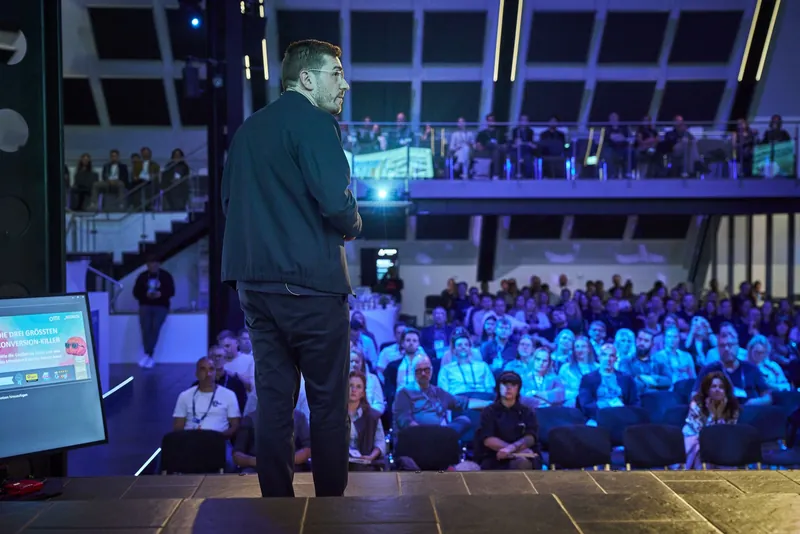
We all want to captivate our customers, don’t we? So for the OMT main stage I invented an online shop for handcuffs. 53 slides of neuromarketing, Friday afternoon, 3.20 pm, and what stuck? The handcuffs. I admit I am not entirely innocent there.
That was on 25 September 2026 in Mainz, at the last OMT in the Pyramide. In the hall sat people who work on websites, shops and campaigns every day. (The talk was in German.)
Background
How the talk came about
Which are the three biggest conversion killers? I asked five AI systems the same question: Google’s AI Overview, Gemini, ChatGPT, Claude and NotebookLM, which I had fed with specialist literature only. The answers were remarkably unanimous. Something is always too much. Then I went window shopping at the big players and looked at what they do about it.
FRED
Through FRED’s glasses
FRED is my name for our brain: Fast, Reward-driven, Emotional, Do-nothing. It decides quickly, always asks “What’s in it for me?”, is anything but rational and, given the choice, lazy. There is a reason for that. The brain makes up around 2 per cent of our body weight but uses about 20 per cent of our energy. And at four pieces of information at once, it is full.
For FRED, every purchase is a calculation: what does it give me, what does it cost me? If the calculation tips, nothing gets bought. That happens particularly often in three places.
First killer
Too much thinking
Anyone who comes into a shop and cannot see the wood for the trees clicks away. In the handcuff shop, six models looked almost the same, with small differences in price. Adding more details to compare makes it worse. The more similar products are, the fewer of them should be shown at once.
Guiding works better: “Buy again” for what is already in the cupboard. “Matches your style” for the next step. And theme pages that nudge gently in one direction, such as handcuffs for weekdays, for the weekend and for special occasions.
Second killer
Too much risk
Can I cross this bridge? Everyone asks themselves that when they order from a shop for the first time. Trust badges help. Neuromarketing can do more. A text describing how the product feels makes it feel a little as if you already own it. Customer reviews work better with a face and a name. And where others are queuing, we like to join in.
I found my favourite example on Amazon: “Customers usually keep this item.” It does not say “return rate below 3 per cent”. I would have to work out what the percentage means first. The sentence says straight away what matters.
Third killer
Too much effort
Effort has two faces: hassle and price. Both hurt. Small first steps help against the hassle: signing up for a newsletter, a wish list, a filled basket. Once you have said yes, the bigger yes comes more easily. Long forms belong in small bites. And anyone at step 27 of 29 will not give up, because otherwise the last ten minutes would be wasted.
A comparison helps against the pain of the price. The police handcuffs cost €65.15, and above it it said “usual price €98.17”. I borrowed the wording from Metro. “Usual price” is understood at once, “manufacturer’s recommended retail price” is not. Whether odd prices like 65.15 or prices ending in nine sell better has not been settled, by the way. In supermarkets, where lots of prices sit side by side, the nines have won.
For SMEs
What SMEs can take from it
You cannot copy Amazon. You do not need to. The three killers can be found in every shop and on every website that collects enquiries. That is why the talk ended with three tasks for Monday morning: where can I guide my customers better? Which fears can I take away from them? Where does it hurt them, and how can it hurt less?
In three words, which in German all start with a V: understand, trust, calculate. And since we were at V anyway: vielen Dank, thank you.
In the Q&A came the question that comes up at every neuromarketing talk: does this apply to B2B too? Yes. Anyone buying a machine for €300,000 needs factual reasons for their colleagues afterwards. The gut decided first all the same.
What participants wrote on LinkedIn afterwards can be found among the testimonials. Thanks to Mario Jung and the OMT team, and to the Website Clinic team I joined on stage afterwards. The photos are by Luisa Reim (NEUBLCK), Peter Krausgrill and Charline Iacono (OMT).
Matching keynote
Who this keynote is for
For marketing conferences, e-commerce events, business days and meetings of marketing and sales teams. The matching talk is Neuromarketing for SMEs. If you want to go deeper into optimisation: The Neuro-Conversion Framework.
FAQ
Frequently asked questions
What are conversion killers?
Places on a website where the buying calculation in the mind tips over: too much thinking, too much risk, too much effort.
Does this apply to B2B too?
Yes. The three killers slow down an enquiry just as much as a purchase.
How long is the talk?
At OMT it was 30 minutes plus questions. Anything from 20 to 60 minutes is possible.
About the author
Christian Dietz
Christian Dietz is a neuromarketing speaker and managing director of the agency NEUBLCK. He gives keynotes for companies, associations and conferences across the German-speaking countries, and in English on request.
This keynote for your event
Tell me briefly about your event. I usually reply within 48 hours.